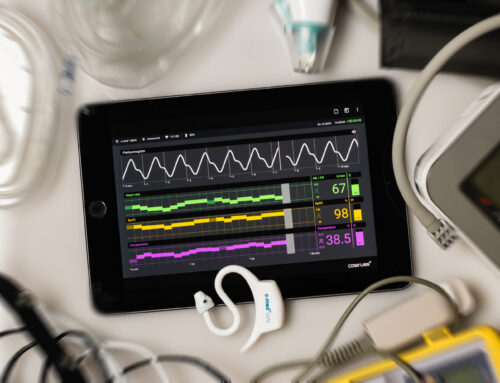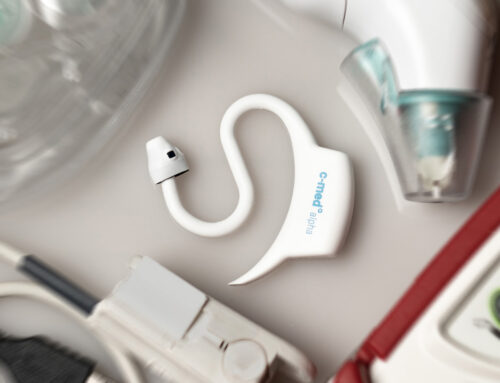


New paper published by cosinuss° on the feasibility of energy expenditure estimation during outdoor walking using in-ear sensors
A study by cosinuss°, together with the Department of Health and Sport Sciences, Exercise Biology, at the TUM School of Medicine and Health in Munich, investigated whether energy expenditure during physical activity can be reliably estimated using an in-ear sensor.
Energy expenditure represents the cumulative energy required for basal physiological processes, diet-induced thermogenesis and physical activity. Monitoring energy expenditure is increasingly important in clinical care, particularly for patients with chronic conditions or those recovering from surgery. Consequently, accurate and reliable individual measurement of activity-related energy expenditure is gaining importance. In response to this growing interest, an increasing number of wearable devices have become available, alongside studies investigating their use for energy expenditure estimation. Although several studies have investigated energy expenditure estimation based on heart rate and accelerometry, no previous study has examined energy expenditure prediction based on heart rate and acceleration data measured simultaneously in the ear canal using a single commercial wearable device. The ear is a promising site for wearable sensing, as in-ear devices are unobtrusive, stable, and well suited for continuous physiological monitoring with reduced motion artifacts. Therefore, the aim of this study was to assess the feasibility of estimating energy expenditure using cosinuss° in-ear sensors1.
Methods and study protocol
Twenty-four healthy adults2 completed two test sessions: a laboratory treadmill test and an outdoor walking test consisting of three phases (uphill walking at a comfortable pace, downhill walking at a comfortable pace, and uphill walking as fast as possible).
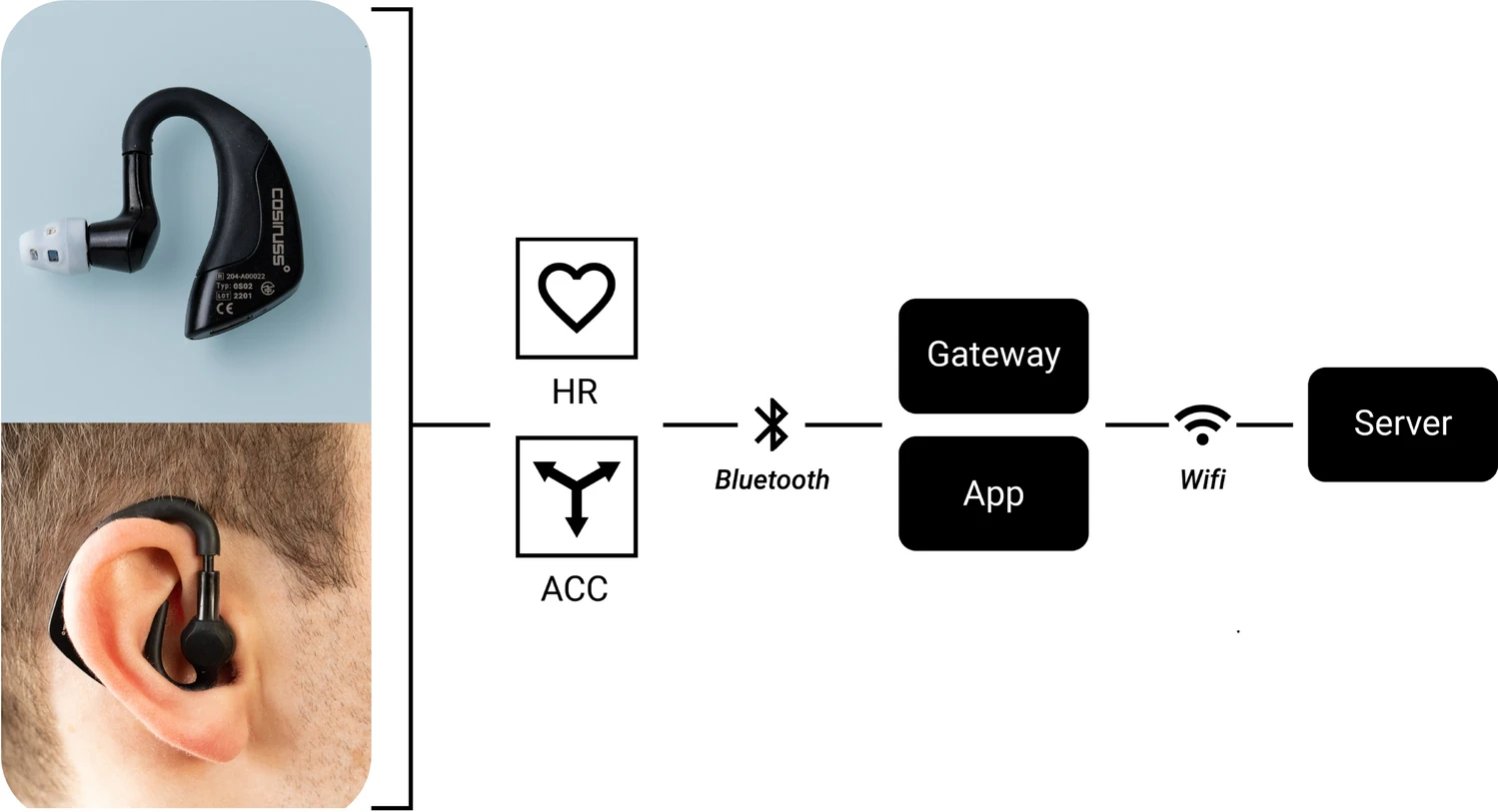
Energy expenditure was measured using indirect calorimetry (MetaMax 3B) as the gold standard, while heart rate and acceleration data were continuously recorded with both cosinuss° sensors. Linear mixed-effects models developed using the laboratory data were then applied to the outdoor data from the same participants.
Promising results
The best-performing models combined heart rate, acceleration data, and biological sex. During outdoor walking, no significant systematic prediction bias was observed, although accuracy varied across the different exercise conditions.
Overall, both cosinuss° sensors showed promising initial results for estimating energy expenditure during walking. The findings indicate that combining different measurement inputs, such as heart rate and movement, has a promising potential for continuous monitoring of energy expenditure.
Further studies with larger and more diverse participant groups and a wider range of movement conditions are needed before the approach can be reliably applied. With further improvements, in-ear sensing could help continuously monitor energy expenditure under everyday conditions in the future, with potential applications in rehabilitation, sports, and chronic disease management.
Feasibility of energy expenditure estimation during outdoor walking using multimodal in-ear sensors: a preliminary validation study against indirect calorimetry.
By David Camargo, Incinur Zellhuber, Michael Weber & Martin Schönfelder
Read the full paper here: https://www.nature.com/articles/s41598-026-64756-6