

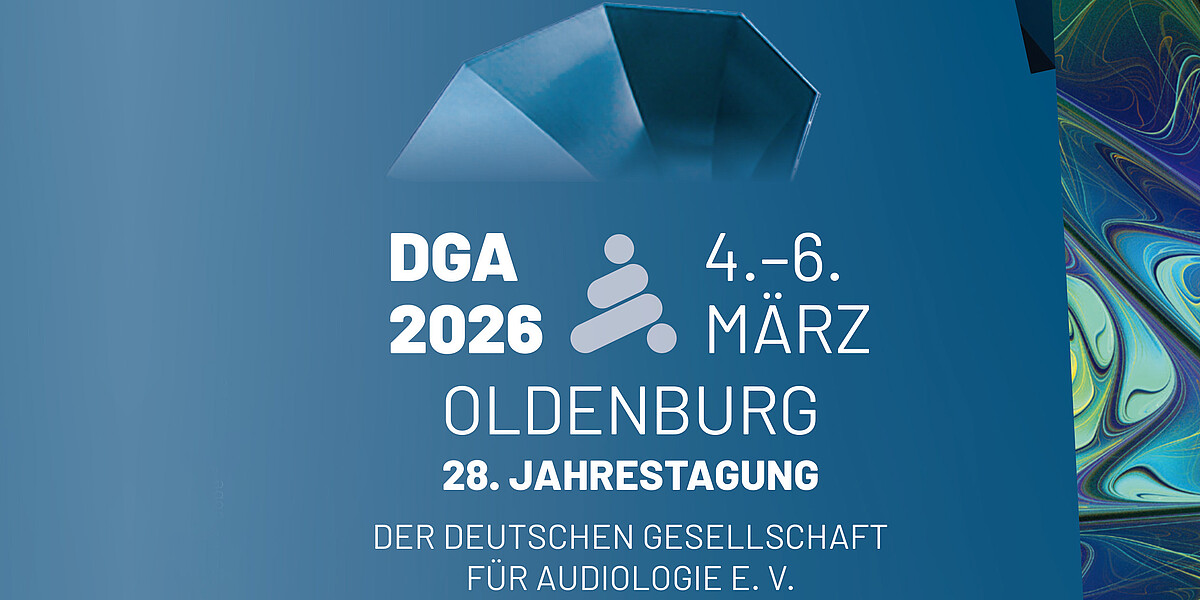
Date: March 4–6, 2026
Location: Oldenburg, Germany
Under the motto “From Precision Audiology to Clinical Practice,” the Deutsche Gesellschaft für Audiologie e.V. (DGA) will present the latest scientific and technological developments in the field of hearing and hearing disorders at its 28th Annual Conference from March 4 to 6, 2026. Innovations from research and technology will be highlighted alongside practical applications for everyday audiological practice. We are pleased that Dr. Johannes Kreuzer has been invited to speak on the precise and continuous monitoring of vital parameters using ear-centered sensor technology.
Focus on Precision Audiology
As precision audiology is already well advanced from a scientific perspective, this year’s conference will address how individualized diagnostics and therapy can be successfully integrated into everyday clinical practice. Participants can look forward to a diverse program with various thematic focuses.
In the session “Clinical Applications of Precision Audiology,” current studies, theoretical approaches, and practical examples will demonstrate how scientifically validated methods are already improving patient care today. Another focus will be “mHealth – From Hearable to Health Hub in the Ear.” This session will explore everyday ear-worn devices, so-called hearables, which not only provide hearing functions but can also collect health data. Modern hearing aids are equipped with integrated sensors that enable the early detection of chronic or acute diseases. The fusion of hearing aids and medical vital sign monitoring represents the future, as it can offer significant benefits both to hearing aid users and to physicians.
Ear-Centered Sensor Technology and Clinical Application
Highly precise monitoring of vital parameters plays a central role in modern medicine. Ear-centered sensor technology offers a promising, non-invasive approach. In his presentation, Dr. Johannes Kreuzer will introduce the in-ear sensor developed by cosinuss°, the c-med° alpha, discuss the advantages of the measurement site, outline the technical and regulatory requirements, and present concrete application examples. Using optical measurement methods and proprietary algorithms, core body temperature, heart rate, and oxygen saturation can already be measured in accordance with medical standards. Additional parameters are also possible: respiratory rate and blood pressure are expected to be included in future regulatory approvals.
If the technology is further combined with a hearing aid—thereby encouraging continuous wear—it will create a wide range of new possibilities and set new standards in predictive medicine and in the management of chronic diseases.
We look forward to engaging discussions with participants about the opportunities that ear-centered sensor technology brings to the digitalization of patient monitoring.
Further information about the presentation:
Date: March 4, 2026, Time: 14:24–14:48, Location / Stream: Lecture Hall 1+2
About the Deutsche Gesellschaft für Audiologie e.V.
The Deutsche Gesellschaft für Audiologie e.V. brings together all professional groups within a scientific society dedicated to the fundamentals of hearing, research into the causes of hearing disorders, as well as their diagnosis, therapy, and rehabilitation. It promotes all aspects of audiology in research, development, teaching, and in clinical and educational practice.