


Blood pressure measurement
Blood pressure measurement without cuff
Blood pressure is one of the most important health indicators. It provides information about how well the cardiovascular system is working and can provide early warning of serious illnesses. High blood pressure often goes unnoticed for a long time and increases the risk of heart attacks, strokes and other serious complications. It is therefore particularly important for people with chronic illnesses or risk factors to keep an eye on blood pressure regularly or even continuously. However, conventional measurement methods are often cumbersome: they interrupt everyday life, are not permanently portable or require invasive interventions when continuous data is required. This is exactly where different companies put development power into: Non-invasive, continuous blood pressure measurement. cosinuss° as well is looking into this, working on the possibility for optical blood pressure measurement (photoplethysmography, PPG for short) in the ear canal.
Working principle of blood pressure measurement based on in-ear PPG
Put simply, the PPG signal is directly related to the blood volume in the vessels in the ear canal, which in turn reflects the blood pressure. If the blood volume increases, the blood pressure also increases. The PPG pulse shape is therefore influenced by the blood pressure, so that changes in blood pressure are directly recognisable in the PPG curve. High blood pressure and arterial vascular stiffness are closely related: High blood pressure makes the arteries stiffer, and stiffer arteries increase systolic blood pressure.1 Increased blood pressure causes the pressure wave in the arteries to spread faster (pulse wave velocity, PWV). This is reflected in a faster pulse wave and a shorter pulse transit time (PTT). In addition, a higher blood pressure causes a greater systolic amplitude, as the heart exerts more pressure on the blood.2 In addition to these visible changes in the PPG curve, there are others. In short, the shape of the PPG wave depends on blood pressure changes that can be traced in the curve (see Fig. 1).
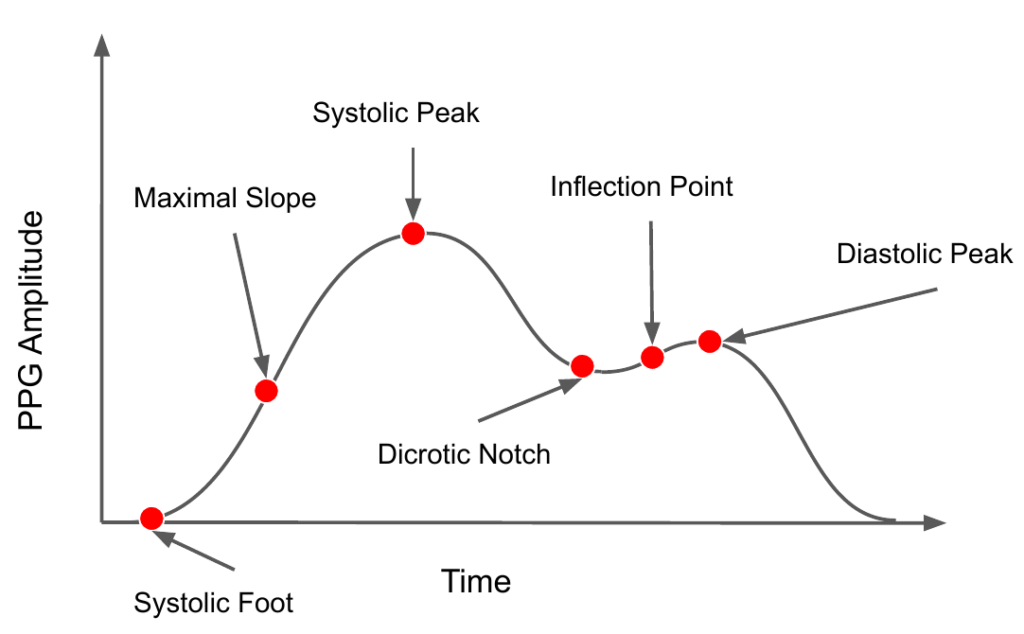
Fig. 1: Schematic amplitude of the pulse curve from a photoplethysmogram (PPG) and its essential features for determining blood pressure.
Complex data processing for blood pressure determination
When measuring PPG, the individual variability of vascular stiffness represents a challenge. The PPG waveforms vary from person to person. The task therefore is to break down each pulse wave into its individual parts and characterize its characteristics. This is a very complex task and needs the usage of neuronal networks which work with different layers. The information generated needs than to be translated into blood pressure values. The parameters shown in figure 1 are just a selection of many parameters that can and should be used to algorithmically evaluate the blood pressure.
Advantages of PPG blood pressure measurement in the ear
Measuring blood pressure in the ear canal using optical measuring methods offers decisive advantages – depending on the application.
If blood circulation in the extremities is restricted, as occurs with hypothermia, among other things, reliable blood pressure measurement can no longer take place in these areas. Especially in cold environments, thanks to easy access to the ear, the patient no longer needs to be undressed or a sleeve cut open to free their arm. Aspects that are particularly important in mountain or offshore rescue. Up until now, the decision has often been made as to whether the patient’s blood pressure should be measured, thereby risking hypothermia, or whether this vital parameter should be omitted, meaning that important changes in the patient’s state of health would not be detected in a timely manner.3
In addition, measurements in the ear canal are less susceptible to movement artifacts, as can occur when measuring on the wrist or finger. The dark environment in the ear canal also offers the advantage that external light influences are minimized, which further improves the signal quality.
Another aspect that affects blood circulation in the periphery: When tourniquets are applied to stop heavy bleeding in the extremities, blood pressure measurements no longer work reliably here either. However, this does not affect the measurement in the ear.4
Measuring with a PPG in-ear sensor therefore offers a non-invasive and continuous method of measuring blood pressure. This also provides for the patient: in increased comfort: A non-invasive, everyday measurement of blood pressure is much more comfortable than conventional methods with cuffs, which, although automatic, contract every few minutes and can feel uncomfortable.
PPG blood pressure measurement based on comprehensive and qualitative data
In recent years, cosinuss° has collected and comprehensively analyzed high-quality data in numerous studies – both internally and in collaboration with clinical partners. Based on this data, the machine learning models can be continuously trained and optimized. This has resulted in a valuable treasure trove of data with information from more than 500 people, over five million heartbeats and almost 60 days of recording. The studies included different scenarios and groups of people to ensure the most realistic and diverse data profile possible. Different measurement aspects were taken into account:
- Static blood pressure monitoring: Recording blood pressure values in defined rest phases. The postures and measurement methods were based on the ISO 81060-2 standard.
- Dynamic blood pressure monitoring: Examination of blood pressure changes during physical exertion (e.g. running, cycling, everyday activities) and during temperature fluctuations – including measurements during surgical procedures.
- Reference measurements: Perform arterial measurements or, if this was not possible, cuff measurements as a basis for comparison.
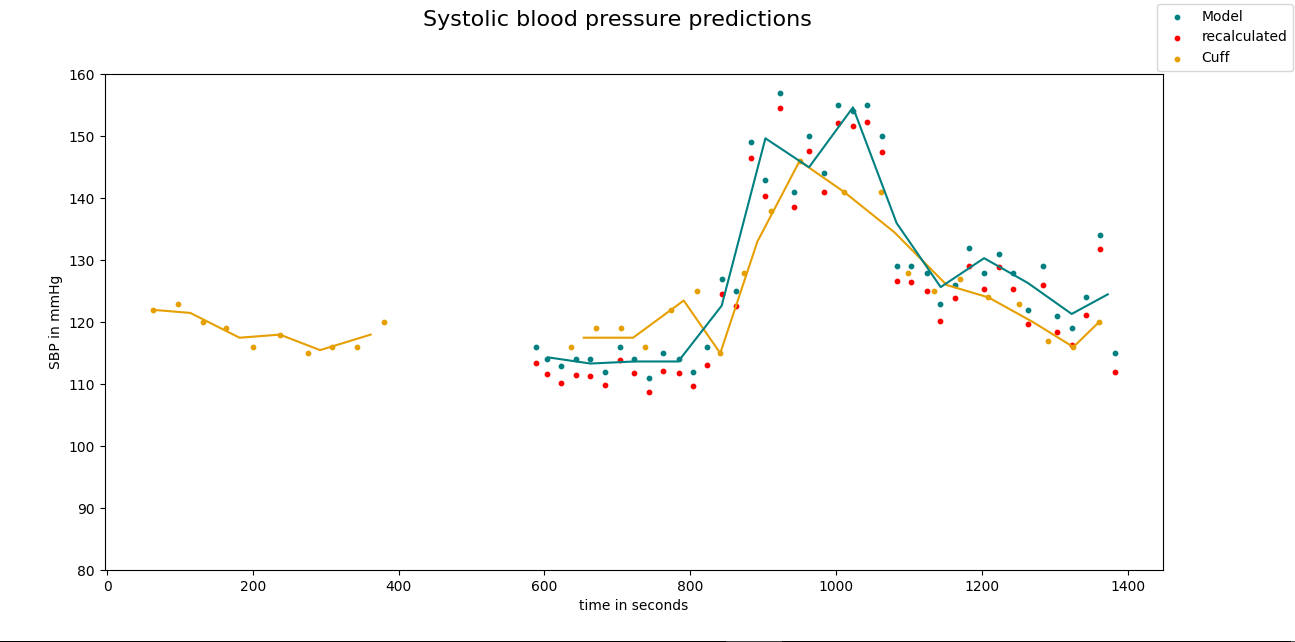
Abb. 2: Comparison of systolic blood pressure measurements using cosinuss°’ predictive model and a standard cuff measurement method over time. The solid line represents the cosinuss° predictions while the dashed line shows the cuff measurements. The x-axis indicates time and the y-axis indicates systolic blood pressure in mmHg.
Quellen / References
- Baulmann, Johannes; Mortensen, Kai; Hess, Otto: Wechselwirkung von Arterieller Gefäßsteifigkeit und arterieller Hypertonie – Pathophysiologie, Basisdiagnostik und Messparameter. In: Der Klinikarzt 2009; 38(3): 132-136, DOI: 10.1055/s-0029-1220670
- Vetter, Christine: Hypertonie: Eine hohe Blutdruckamplitude weist auf kardiovaskuläres Risiko hin. In: Deutsches Ärzteblatt 9/2024
- These statements are based on the experience of cosinuss° patient monitoring users.
- These statements are based on the experience of cosinuss° patient monitoring users.